Pediatric right-AAOCA: patient counts, operation rates, techniques, and follow-up side by side
Read only surgical series and repair looks safe and mature. Read only real-world cohorts and most children are not operated on. These findings are not contradictory: one asks how selected operations perform; the other asks who crosses the threshold for surgery after diagnosis.
This page was assembled by AI from the library records, PubMed metadata/abstracts, and available full texts. No medical professional reviewed it. The figures explain studies; they do not guide individual care. NR means not reported in the accessible article information.
01 · Bottom line
Bottom line: the hardest question is not how to repair, but whom to repair
Right-AAOCA does not mean automatic surgery
Across pediatric and adolescent real-world cohorts, roughly 18%–37% underwent repair. Different definitions and referral patterns mean those percentages must not be pooled.
High-risk anatomy is not one switch
An intramural course matters, but so do ostial minimum diameter, the length of proximal narrowing, symptoms, and evidence of ischemia under exercise-like stress.
Repair is mature, not cost-free
Unroofing and reimplantation have low mortality at experienced centres, while multicentre data still record aortic insufficiency, coronary reoperation, and a small number of postoperative deaths.
02 · Evidence timeline
How the evidence changed
Early work largely established that repair could be done safely. Recent work asks who actually develops dynamic flow limitation.
- Maturing unroofing and anatomy-led repair series
- CHSS multicentre data quantify the cost of repair
- An AAORCA-only cohort demonstrates selective surgery
- Pediatric real-world cohorts meet dynamic physiology
03 · Real-world operation rates
Separate “how many are operated on?” from “how well does surgery work?”
These four cohorts can inform real-world selection. The Japanese and Texas cohorts include left-AAOCA, so they are not pure right-AAOCA estimates.
| Cohort | Total | Operated | Observed / not repaired |
|---|---|---|---|
| 广东儿童纯 AAORCA / Guangdong pediatric AAORCA | 151 | 46 (30.5%) | 105 (69.5%) |
| Bibevski 纯 AAORCA / AAORCA-only | 86 | 26 (30%) | 60 (70%) |
| 日本儿童混合 AAOCA / Japan pediatric AAOCA | 106 | 39 (36.8%) | 67 (63.2%) |
| Texas Children’s 混合 AAOCA / pediatric AAOCA | 573 | 102 (17.8%) | 471 (82.2%) |
04 · Patient-data comparison
Patient data, study by study
The 20-paper reading set yields 14 cohorts or case series plus one mechanistic case report. They answer different questions and are not pooled.
| Study | Population and count (total / AAORCA) | Age | Intramural/proximal anatomy | Operation rate | Technique | Follow-up | Death/ischemia/reintervention | What it actually answers |
|---|---|---|---|---|---|---|---|---|
| 广东省心血管病研究所 2026 | Pediatric AAORCA-only151 / 151 | Mean 7.4 y | Among 45 with operative anatomy: 44 intramural, 40 ostial stenosis | 46/151 (30.5%) | 44 unroofing; 1 reimplantation; 1 heart transplant | Short available follow-up; no common median | No perioperative death; no SCD/MACE in available follow-up | Selective surgery; anatomy and symptoms often diverged |
| 日本全国儿童调查 2026 | Pediatric AAOCA; 71 right-sided106 / 71 | Median 9.1 y | Intramural course independently associated with symptoms; count NR | 39/106 (36.8%) | NR | Followed to median age 12.2 y | All survived; one presenting arrest was followed by heart transplant | Management integrated symptoms, anatomy, and stress testing |
| Bibevski 2022 | AAORCA-only86 / 86 | Median 16 y | Slit-like ostia and longer proximal narrowing were more common with surgery | 26/86 (30%) | 10 unroofing; 7 neo-ostium; 6 modified unroofing + neo-ostium; 2 unroofing + reimplantation; 1 reimplantation | Median 3 y; up to 13 y | No ischemia on follow-up functional testing after surgery | A clear example of selective surgery in right-AAOCA |
| Stanford / Mainwaring 2014 | Selected surgical AAOCA; 47 right-sided76 / 47 | Median 15 y | 55 underwent unroofing of an intramural segment | 100% (surgical series) | 55 unroofing; 7 reimplantation; 14 PA translocation | Median 6 y | No early or late death; one later heart transplant for severe ischemia | Supports anatomy-led repair at an experienced centre |
| Mayo / Sharma 2014 | Selected unroofing patients; 69 AAORCA75 / 69 | Mean 39.6 y | All underwent unroofing; intramural proportion NR | 100% (surgical series) | 75 unroofing; 2 also required CABG | Mean 18 mo; up to 7 y | No early death; one non-cardiac late death | Supports mature unroofing for suitable anatomy |
| 成人 AAORCA 再植 2026 | Symptomatic adult AAORCA40 / 40 | Median 44 y | Intramural or interarterial course | 100% (surgical series) | 40 reimplantations; one additional vein graft | Mean 30.3 mo | No death; all 14 re-imaged vessels had no ostial stenosis or kinking | Supports adult reimplantation in selected cases; not directly pediatric |
| Ramponi / Puskas 2024 | Adult AAORCA13 / 13 | Mean 53.9 y | 13/13 slit-like ostium, long intramural and interarterial course | 100% (surgical series) | 13 formal unroofing | Mean 20.1 mo | No 30-day death/MI; no reintervention | Strong anatomy–technique match for long intramural segments |
| CABG 队列 2023 | Mixed adult anomalies; 6 strict AAORCA14 / 6 | Median 62.5 y | 7 also had flow-limiting coronary disease | 100% (CABG series) | 14 internal-thoracic-artery CABG | Median 43 mo | No perioperative death; one graft failure | Highlights competitive-flow risk without fixed severe stenosis |
| R-AAOCA CCTA + FFR 2026 | Adult R-AAOCA81 / 81 | Mean 52.3 y | Measured ostial and intramural minima plus geometry-based resistance | Non-surgical study | — | — | Abnormal adenosine FFR 6.2%; dobutamine FFR 19.8% | Stress-like testing exposed more limitation than vasodilation alone |
| iFR + 多巴酚丁胺 2019 | Adult AAORCA case report1 / 1 | Adult | Suspected exercise-induced dynamic obstruction | Mechanistic case | — | — | Dobutamine + iFR used to simulate exertional physiology | Mechanistic evidence, not natural-history evidence |
| CCTA + 运动 SPECT 2026 | Mixed adult AAOCA35 / NR | Mean 51 y | 60% had at least one high-risk CCTA feature | NR | — | Median 59 mo | 51% had inducible ischemia on exercise SPECT | Supports integrating anatomy with function |
| 运动负荷超声 2025 | Mixed adult AAOCA46 / NR | Mostly middle-aged adults | 17% intramural; 70% interarterial; 24% slit-like ostium | 4/46 (8.7%) | NR | Median 3 y for non-operated patients | Only one positive ESE; no adverse cardiovascular events in those observed | Argues against operating on anatomy labels alone |
| 儿童多巴酚丁胺负荷 CMR 2025 | Mixed pediatric/young coronary disease64 / NR | Median 5.3 y | Not an AAOCA-specific cohort | Non-surgical study | — | Median 7.4 y | No MI, death, or aborted sudden death among 61 negative studies | Supports radiation-free functional stratification in children |
| 成人 CCTA 自然史 2015 | Mixed adult anomalies; 36 right-from-left114 / 36 | Adult | 56/114 had at least one high-risk feature | 10/114 (8.8%) | NR | Mean 27.1 mo | No cardiac death or acute coronary syndrome | Supports adult functional stratification; not directly pediatric |
| Texas Children’s 2026 | Pediatric AAOCA; 77.8% right-sided573 / 446 | Mean 10.5 y | Cross-sectional exercise/BMI database; intramural proportion NR | 102/573 (17.8%) | NR | Cross-sectional | 85/573 (14.8%) had ischemia on advanced imaging | Even at a large specialist centre, diagnosis did not mean automatic surgery |
05 · Unroofing or reimplantation
Unroofing vs reimplantation: let the anatomy choose
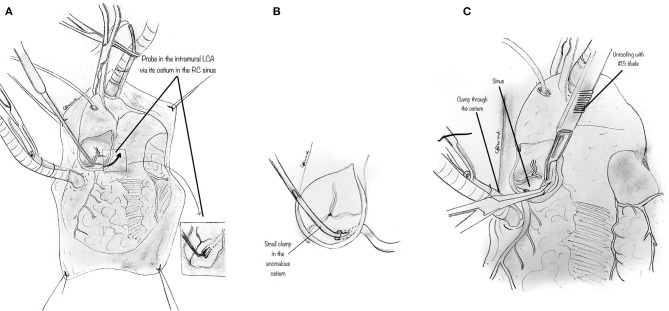
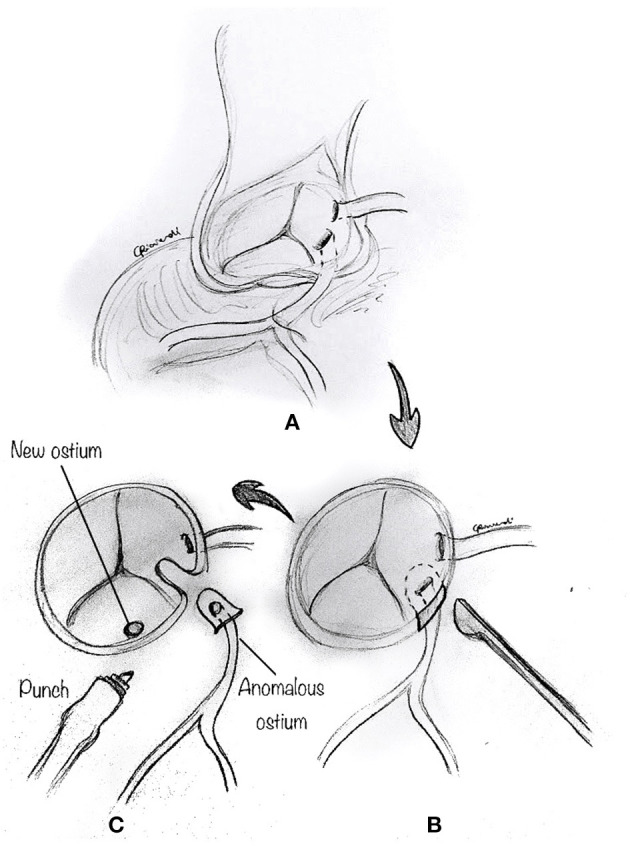
No evidence establishes one best repair for every AAORCA. The issue is which operation actually corrects the abnormal ostium and proximal narrowing.
These are published operative-technique drawings used to explain the steps. They are not Jim’s imaging and do not represent an individual child’s surgical plan.
A long, definite intramural segment
When unroofing can create a well-positioned, generous new ostium, it is direct and well established. All 13 adults in the Ramponi/Puskas series had a long intramural segment and underwent formal unroofing, with no death, MI, or reintervention over about 20 months.
A short intramural segment or an unsatisfactory ostium after unroofing
Reimplantation or neo-ostial reconstruction becomes more attractive because it changes where the artery starts. A 40-adult reimplantation series reported good intermediate patency, but it cannot be directly extrapolated to an eight-year-old.
CABG is rarely the default fallback in a young patient
Without severe fixed stenosis, native RCA flow competes with the graft. One graft failure occurred in a 14-adult CABG series, whose authors specifically caution about patients without flow-limiting disease.
06 · Why dynamic ischemia matters
The newer question is not only “where does it run?” but “does it obstruct under stress?”
In 81 adults with R-AAOCA, adenosine FFR—more reflective of fixed narrowing—was abnormal in 6.2%. Dobutamine FFR, closer to the higher heart rate and pressure of exercise, was abnormal in 19.8%. Adult data cannot be applied directly to children, but the contrast makes the dynamic mechanism visible.
07 · Repair does not erase risk
Repair does not reset lifetime risk to zero
The CHSS enrolled 682 people with AAOCA aged 30 or younger; 395 underwent surgery at 45 centres, with median follow-up of 2.8 years. Unroofing formed part of 87% of repairs. The study shows low mortality and frequent relief of ischemia, while also documenting real morbidity.
The denominators differ: aortic insufficiency was assessed among 358 with paired evaluations, while ischemia resolution uses the 64 with preoperative ischemia. These figures must not be added together.
Open the CHSS record08 · The decision chain
The 20 papers as one decision chain
- 1R-AAOCA
- 2Exertional symptoms
- 3Ostium and proximal minimum
- 4Intramural segment and length
- 5Ischemia under dynamic stress
- 6Surveillance or anatomy-led repair
The combined evidence supports neither “observation is best” nor “early repair is safest.” It supports finding the smaller group whose natural-history risk is likely to exceed the cost of a low-risk open-heart repair.
Sources
Records used in this analysis
Open a library record for its DOI, PMID, access status, and curator note.
- 广东 151 例儿童 AAORCA / Guangdong pediatric AAORCA
- 日本全国儿童调查 / Japan nationwide pediatric survey
- Bibevski:手术与非手术 AAORCA / Surgical and nonsurgical AAORCA
- Stanford:按解剖选择修复 / Anatomy-led surgical repair
- Mayo:去顶术系列 / Unroofing series
- 成人 AAORCA 再植 / Adult AAORCA reimplantation
- 成人长壁内段去顶 / Adult long-intramural unroofing
- AAOCA 的 CABG / CABG for anomalous coronaries
- CCTA 几何参数与 FFR / CCTA geometry and FFR
- 多巴酚丁胺 iFR 机制病例 / Dobutamine-iFR mechanistic case
- CCTA + 运动 SPECT / CCTA + exercise SPECT
- 运动负荷超声 / Exercise stress echocardiography
- 儿童多巴酚丁胺负荷 CMR / Pediatric dobutamine stress CMR
- 成人 CCTA 自然史 / Adult CCTA outcomes
- Texas Children’s 573 例 / 573-patient pediatric cohort
- CHSS 多中心手术结局 / CHSS multicentre repair outcomes